April 22, 2026 · David Strickler
Bringing a Vintage Kukri Back to Life, Kane's Blade Restoration
A good friend brought me a vintage kukri that had seen better days. Here's how we took this traditional Nepalese blade from dull and neglected back to a working edge worthy of its heritage.
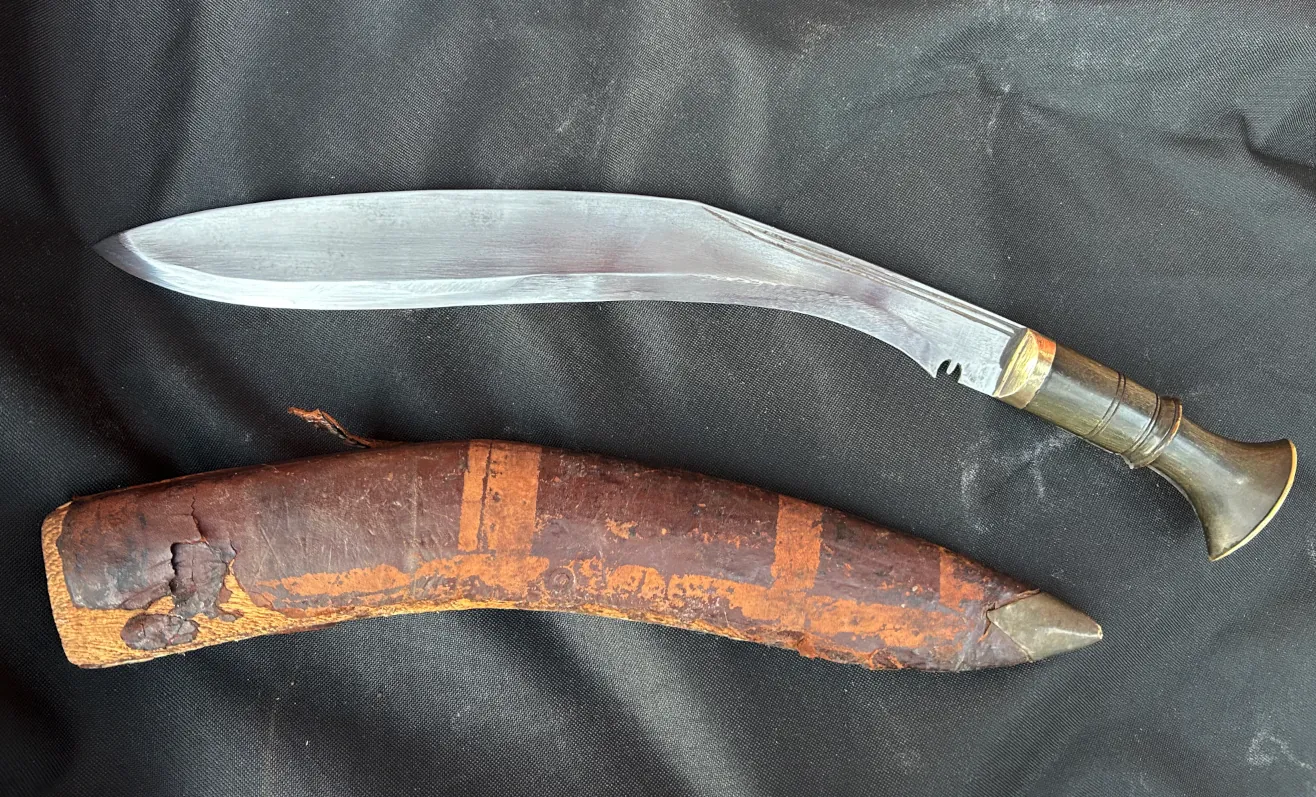
When my buddy Kane pulled this one out of the bag, I knew we were in for a fun project. What he handed me was a kukri — the iconic curved blade from Nepal, famously carried by Gurkha soldiers for generations. It's one of the most distinctive knife designs on earth, and one of the most functional. That forward-heavy curve isn't just for looks. It turns the blade into part knife, part hatchet, and it chops way above its weight.
Kane's kukri had clearly been through some life. The leather scabbard was worn soft with age, the brass fittings had that beautiful dark patina you only get from decades of handling, and the edge was completely shot. Dull, dinged up, and not cutting much of anything. But under all that neglect was a solid piece of steel with a lot of fight left in it.
The Process
A kukri isn't your average kitchen knife. The blade has a distinct curve and a differentially hardened edge, meaning the metal hardness changes as you move along the blade. You can't just slap it on a pull-through sharpener and call it a day — you'll ruin the geometry and the temper.
I worked the edge in sections, following the natural curve of the blade. Started with coarser stones to reset the bevel and remove the damage, then stepped through progressively finer grits to refine it. The belly of the blade — that thick, curved section that does most of the chopping — got extra attention since that's where the real work happens on a knife like this.
After the edge was set, I cleaned up the blade, conditioned the leather scabbard a bit so it wouldn't crack any further, and gave the brass a gentle touch-up without stripping that earned patina. Some character you don't polish away.
The Result
Shaving sharp from tip to notch, and ready to do the job it was built for. Kane was stoked, and honestly so was I. These are the projects I love — when someone brings in a blade with history and we get to give it another lifetime of use.
Got a Blade That Needs Bringing Back?
Whether it's a family heirloom, a vintage collectible, or your everyday kitchen workhorse, I can get it back to working sharp. Reach out and let's talk about your blade.