February 26, 2026 · David Strickler
Why Your "Sharp" Knives Are Still Squashing Tomatoes: The DIY Sharpening Trap
We’ve all been there. You’re prepping dinner, and your favorite chef’s knife won’t even break the skin of a bell pepper. You grab that pull-through sharpener from the junk drawer, run the blade through a few times, and... it’s slightly better, but it still feels "toothy" and jagged.
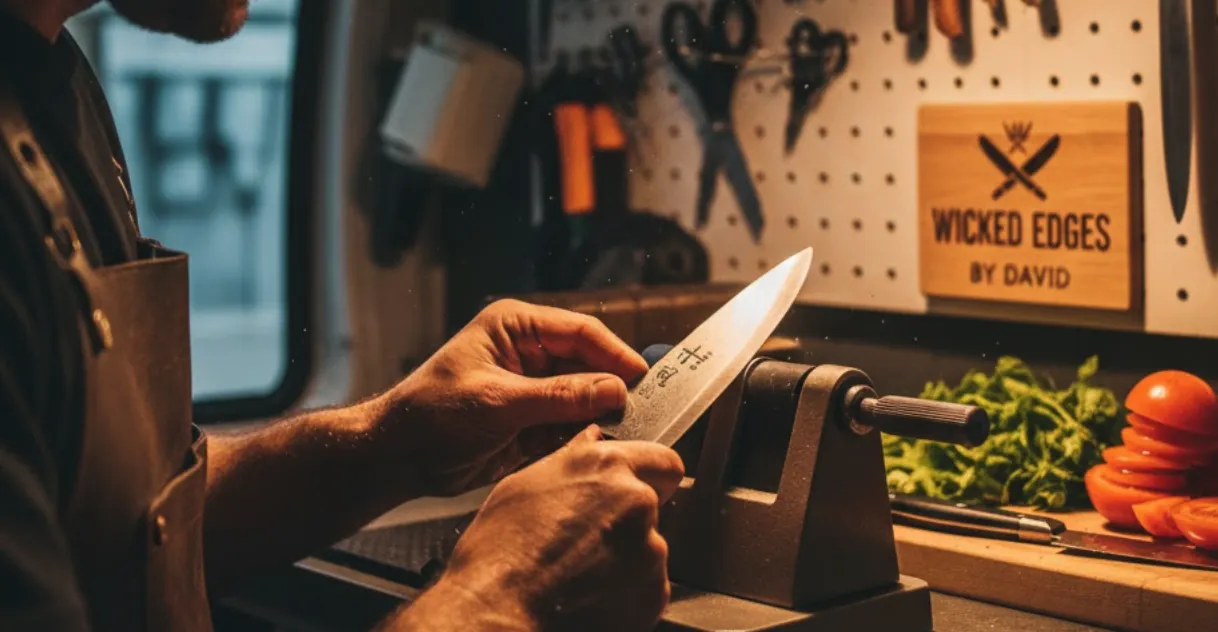
In the sharpening world, there is a massive difference between "scraping an edge" and "refining a bevel." At Wicked Edges by David, we see a lot of "DIY disasters" come through our shop in Escondido. From beautiful Japanese steel ruined by electric grinders to expensive shears that have been "sharpened" with a hand file. If you want to know why your home sharpening isn't working—and why a professional touch changes everything—this guide is for you.
- The Mystery of the "Burr"
Most home sharpeners fail because they don't understand the burr. When you sharpen a knife, you are actually pushing metal to one side until a microscopic "wire" of metal forms on the opposite side.
If you don't successfully create that burr, and then—more importantly—successfully remove it, your knife will feel sharp for exactly three cuts before that wire edge rolls over, making the knife duller than when you started. We use a multi-stage stropping process to ensure that burr is gone, leaving nothing but a clean, razor-sharp apex.
- The Danger of the Pull-Through Sharpener
Those V-shaped pull-through sharpeners you find at big-box stores in North County work by literally shaving metal off your knife. They don't sharpen; they "carbide strip."
The Result: They leave a ragged, saw-like edge that tears food instead of slicing it.
The Damage: Over time, they create a "recurve" in your blade, making it impossible for the knife to sit flat on a cutting board.
- Angle Consistency: The 1-Degree Difference
A standard Western kitchen knife is usually ground at 20 degrees. A high-end Japanese knife is often at 15 degrees. If you are sharpening by hand on a stone and your wrist wobbles by just 2 or 3 degrees, you are "rounding" the edge rather than sharpening it.
David uses a precision-guided system in his Escondido workshop. This ensures that whether we are working on a paring knife or a heavy-duty cleaver, the angle is locked in and perfectly consistent from the heel to the tip.
- Beyond the Kitchen: The Specialized Edge
Sharpening isn't just for chefs. We’ve become the go-to local resource for:
Gardeners: Loppers and pruners that actually cut clean, preventing disease in your plants.
Woodworkers: Chisels that can shave hair.
Crafters: Fabric shears that glide through silk without snagging.
The Wicked Edges Guarantee
Working as an independent sharpener in Escondido, David treats every blade like a piece of high-performance machinery. We don't just "grind and go." We inspect the steel, repair nicks in the edge, and return a tool that is often better than the day it left the factory.
Stop the Struggle. Get an Edge.
Don't waste another afternoon struggling with stones and gadgets. Bring your blades to the Hawthorne Country Store or schedule a mobile sharpening visit anywhere in San Diego County.
Keywords to remember:
Knife sharpening near me
How to sharpen garden tools Escondido
Professional scissor sharpening San Diego
Wicked Edges by David
Precision. Craft. Convenience.