November 21, 2025 · David Strickler
The Science of Sharp: Why My "Wet Stone" Process is Safer for Your Knives
Are cheap, fast sharpeners ruining your good knives? High-speed grinders create heat that destroys steel temper, making blades go dull instantly. Dive into the science behind David's 4-step, slow-speed wet stone process. Learn how this water-cooled technique protects your investment and achieves that perfect, lasting mirrored edge, all delivered right to your driveway in Escondido.
If you are looking for mobile sharpening services in Escondido or the surrounding North County area, you’ve probably noticed a lot of options. Some guys offer fast, cheap sharpening right out of a van using high speed belt sanders.
While that might get you a sharp edge for a few days, it often comes at a terrible cost: ruined steel.
At Wicked Edges by David, I do things differently. I believe that proper knife sharpening isn't just about removing metal, it’s about refining an edge while protecting the integrity of the blade.
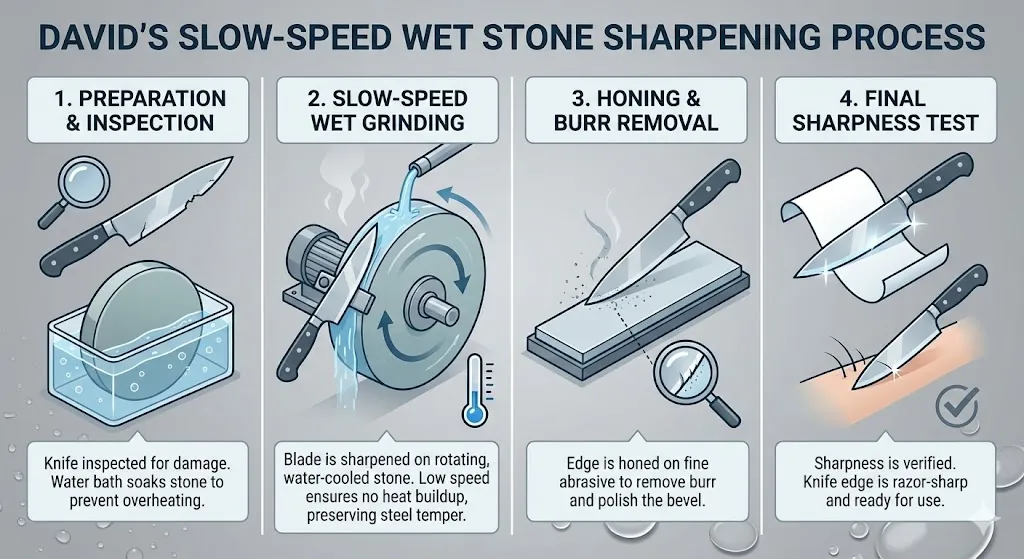
If you look at the infographic above, you’ll see the exact four step process I use to bring your kitchen cutlery, serrated knives, and garden tools back to better than factory sharp.
Here is a breakdown of why this method matters for your expensive tools.
The Danger of Heat (What I Avoid)
The biggest enemy of a knife blade is heat. The steel in quality knives is heat-treated (tempered) to be hard enough to hold an edge.
When a typical sharpener uses a dry, high speed grinder, friction heats the very edge of the blade instantly. If you see sparks flying, that’s bad news. That heat ruins the temper, making the metal soft. A soft edge rolls over and gets dull almost immediately after you use it.
Step 1 & 2: The Wet Stone Difference
As you can see in the second panel of the image, I use a slow speed, water cooled system.
The stone sits in a water bath. As it rotates slowly, it carries cool water up to the blade where the grinding happens. This ensures that the steel never gets hot. By keeping the blade cool, the temper is preserved, meaning your knife will stay sharper for much longer.
Step 3: Achieving the "Mirrored Edge"
Grinding is only half the battle. The real magic happens in step three: honing and burr removal.
After shaping the edge on the wet stone, there is a microscopic, rough wire edge called a "burr." If you don't remove it correctly, the knife will feel jagged.
I spend extra time honing the blade on fine abrasives. This doesn't just remove the burr; it polishes the bevel of the blade to a high luster. This is how we achieve that highly sought after mirrored edge. A polished, mirrored edge has less friction, meaning it glides through food effortlessly, the true sign of a professional sharpen.
Step 4: The Final Test
I don't hand a knife back until it passes the test shown in panel four, cleanly slicing paper or shaving hair with zero drag.
If you are in Escondido, San Marcos, or anywhere in North County and want your knives treated with this level of care, contact me today. I’ll bring the workshop right to your driveway.